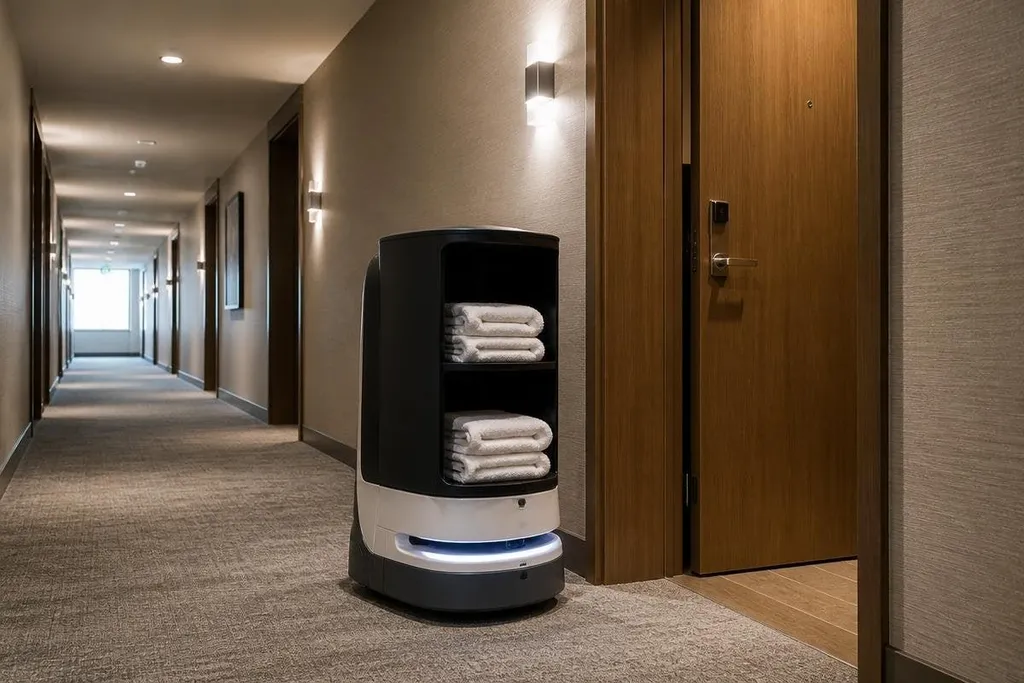
A robot carrying towels to a guest room changes a hotel stay in a small but visible way: the guest gets the item without waiting for a staff member to leave the front desk. That same machine also changes how a hotel plans work, handles safety, and measures service.
- Robots can move items, guide guests, or clean shared areas.
- Guest contact depends on voice, screens, lighting, and safe movement.
- A useful pilot needs a clear task, a human fallback, and measured results.
The work guests can see
The clearest use is moving things through a hotel. A mobile robot can carry room supplies, food, or laundry between fixed points, then alert staff or the guest when it reaches the destination.
That takes a repeat trip out of a worker’s shift. It doesn’t remove the need for a person, because staff still load the robot, check the order, handle exceptions, and speak with guests who need help.
Guide robots work in a different way. They can lead a guest toward a lift, meeting room, restaurant, or reception desk. A screen can show directions, while microphones and speakers support short exchanges.
The quality of that exchange matters. A guest who can’t hear the robot, read its screen, or tell where it is going may feel less helped than before. Hotels need clear routes, readable text, and a human nearby when the request falls outside the robot’s limits.
The machine behind the welcome
Most service robots use cameras, LiDAR, or both to locate walls, people, and other objects. LiDAR measures distance with light, giving the robot a map of nearby space. Software then chooses a route and changes it when someone blocks the way.
That process works best in places with known routes and repeatable layouts. A hotel lobby can change within minutes when guests bring luggage, staff move furniture, or an event opens a new queue. The robot needs a safe stop and a clear handoff when its route no longer fits.
Voice control adds another layer. Background music, several people speaking at once, and guests using different accents can make speech harder to read. A touch screen, room number check, and visible status light give the guest another way to finish the task.
The small details shape trust. A door that stays closed, a lift the robot can’t call, or a delivery placed in the wrong corridor matters more than a polished demo. I’d judge a hotel robot by its recovery when a task goes wrong, not by its smoothest trip.
What changes for hotel staff
A robot shifts work before it removes work. Someone must charge it, clean its sensors, refill its storage space, watch its alerts, and fix problems at the handoff point.
That means the hotel needs a new work plan. Staff should know who owns each alert, how long a robot may wait in a corridor, and when a person takes over. Without those rules, a robot can create extra calls for the front desk instead of reducing them.
A hotel buyer can compare those handoffs with hospitality robotics reporting from Robot24.com to see whether a machine’s claimed task fits a real hotel shift.
Guest reactions also need care. Some people may enjoy the novelty, while others want a quiet human exchange. Hotels should keep a staffed option visible instead of forcing every guest through a robot-led process.
What remains unproven
A robot can finish a repeat task. That doesn’t prove it improves the whole stay. A hotel buyer needs results from the exact setting: busy lifts, narrow corridors, room service peaks, cleaning schedules, and the number of staff available to step in.
With no named deployment, measured result, price, or service record in the supplied material, this article can’t claim a time saving or a return on investment. Those figures should come from a hotel’s own pilot or a named source, not from a product video.
Privacy needs the same care. Cameras and microphones may process information about guests, workers, and room locations. The hotel should set clear rules for what the robot records, where data goes, who can access it, and how long it stays stored.
Safety is physical as well as digital. A hotel must test stops near children, luggage, wheelchairs, wet floors, stairs, and crowded lifts. The robot also needs a visible emergency stop and a route that leaves enough room for people to pass.
A practical pilot checklist
Before a hotel puts a service robot in front of guests, the team should check:
- Pick one task: choose a repeat trip with a clear start, finish, and human handoff.
- Map the route: record doors, lifts, ramps, narrow points, and places where queues form.
- Set the fallback: name the staff member who takes over when the robot stops or a guest needs a person.
- Measure the work: track completion time, failed trips, staff interventions, guest requests, and safety stops.
- Test access: run the task with luggage, wheelchairs, children nearby, poor lighting, and a crowded lobby.
- Set data rules: state what cameras and microphones record, who sees it, and when it is deleted.
Start with a task guests already understand. If the robot can’t finish that task safely during a busy shift, a larger rollout will only spread the same problem.
The useful measure is simple: how many guest requests the robot completes without adding work for staff. Until a hotel can show that number from its own floors and shifts, the machine remains a trial, not a service plan.